ASUS Adopts NVIDIA DSX AI Factory Platform to Accelerate Time to First Revenue
Delivering a total AI factory solution from blueprint to deployment, accelerating token generation and enterprise AI adoption
TAIPEI, June 2, 2026 /PRNewswire/ -- ASUS today announced its latest AI infrastructure solutions showcase at Computex 2026, delivering end-to-end AI factory capabilities in collaboration with ecosystem leaders including NVIDIA, Intel® and AMD. Spanning rack-scale AI factories and POD architectures to ultrafast content memory storage solutions and enterprise-ready agentic AI applications, ASUS provides enterprise with a complete foundation for the entire AI lifecycle — from infrastructure design and deployment to large-scale token generation, inference, and real-world business adoption.
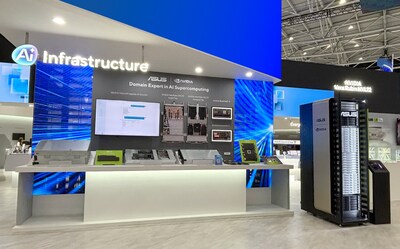
By providing flexible, tightly integrated solutions across compute, storage, networking, and software, ASUS empowers enterprises to build, deploy, and optimize high-performance AI infrastructure at scale —significantly accelerating time to market while maximizing operational efficiency, cost-effectiveness, and strategic agility in an increasingly AI-driven competitive landscape.
Accelerating token generation with NVIDIA DSX
ASUS is at the forefront of AI infrastructure with the XA VR721-E3, ASUS AI POD built on NVIDIA Vera Rubin NVL72, a 100% liquid-cooled rack-scale platform purpose-built for trillion-parameter models and next-generation AI factories. To facilitate the deployment of these advanced AI capabilities and leverage the NVIDIA DSX platform for token generation, ASUS assists customers to simulate the AI factory blueprints into deployment-ready infrastructure. By integrating ASUS rack-scale AI systems with NVIDIA DSX customers can comprehensively evaluate critical deployment factors — including power delivery, cooling design, networking topology, storage integration, and facility readiness — before physical buildout commences. This is further enhanced through OpenUSD-based digital-twin workflows, where ASUS and ecosystem partner solutions are represented as simulation-ready assets, enabling customers to accurately anticipate infrastructure requirements and optimize deployment plans in advance.
Addressing rigorous AI workload demands, ASUS will also showcase systems accelerated by NVIDIA HGX Rubin NVL8 and Intel® Xeon® 6 processor, including XA NR1I-E12L, an innovative hybrid-cooled option, and XA NR1I-E12LR, a 100% liquid-cooled system. The lineup also includes XA NB3I-E12, featuring NVIDIA HGX B300, delivering high-performance acceleration for training, inference and simulation. The portfolio is further strengthened by a comprehensive lineup of high-performance, scalable NVIDIA MGX servers. Making their debut are XA P8A-E14AXL, a high-density 6U system supporting eight liquid-cooled NVIDIA RTX PRO 6000 Blackwell Server Edition GPUs; and XA P4N-E2, a 2U AI server powered by NVIDIA Vera C2 processors for next-generation agentic AI systems. ASUS will also showcase its ESC8000 series, including ESC8000-E12P and ESC8000A-E13P, supporting NVIDIA RTX PRO 6000 Blackwell and RTX PRO 4500 Blackwell Server Edition GPUs for demanding AI, data processing, video and visual computing workloads, as well as ESC8000A-E13X, integrated with NVIDIA ConnectX-8 SuperNICs for extreme GPU-to-GPU connectivity.
For broader enterprise and general-purpose applications, ASUS presents the latest RS700A/RS720A/RS500A/RS520A series servers featuring 6th generation AMD EPYC CPU. Together, these platforms ensure flexible infrastructure options across AI, HPC, virtualization and data-driven workloads, reinforcing the ability of ASUS to support customers from large-scale AI factories to everyday enterprise computing.
Strengthening context memory and storage for scalable inference
As AI workloads evolve toward long-context, multi-turn and agentic workflows, inference context has become a major infrastructure bottleneck. ASUS addresses this with the new CMX™ storage server, UF920-E3-RS24, powered by NVIDIA Vera CPU with NVIDIA BlueField-4 DPU and NVIDIA ConnectX-9 SuperNIC. This platform delivers high-performance KV cache access to accelerate token generation for training, inference and enterprise-scale AI deployments. In collaboration with WEKA and IBM, it offers advanced data management, intelligent services and high-speed storage access, optimizing AI data pipelines and maximizing GPU utilization and overall compute efficiency. This reinforces ASUS as a total AI infrastructure solution provider, delivering integrated compute, storage, networking, and software integration to power enterprise AI at scale.
Enabling token consumption across enterprise and vertical AI adoption
For token consumption, ASUS demonstrates how its total AI infrastructure — built on scalable NVIDIA MGX architecture, NVIDIA RTX PRO Servers, NVIDIA Jetson edge computers and enterprise-ready software — can serve as the foundation for diverse AI adoption across enterprises, SMBs, traditional industries and healthcare. Working with industry innovators and ecosystem partners, ASUS enables customers to turn AI infrastructure into practical, vertical-ready workflows, including:
- Enterprise AI enablement: ASUS AI Hub with NVIDIA NemoClaw, deployed on ESC8000A-E13X, offers enterprise-level agentic tools to create autonomous AI assistants, support secure on-premises AI workflows and enable seamless knowledge retrieval through a curated library of personalized prompts. Built for scalable internal use, ASUS AI Hub can support role-based assistants such as HR, coding and legal assistants, helping teams streamline knowledge access, improve productivity and conduct preliminary compliance review in a controlled environment.
- Smart healthcare innovation: ASUS Smart Healthcare Solutions integrates ASUS handheld ultrasound and ASUS VivoWatch technologies with NVIDIA NeMo open libraries, enabling secure on-premises hospital AI workflows through the ASUS Healthcare AI Agent Platform. Through a vertically integrated ecosystem spanning AI computing infrastructure, smart medical devices and healthcare data platform, ASUS delivers a comprehensive one-stop solution for hospitals and healthcare providers, supporting AI-powered clinical decision support and driving medical innovation.
In addition, ASUS collaborates with ecosystem partners such as Dobby DeepAgent Platform and NunoX to expand agentic AI and industry-specific AI adoption across SMB operations and traditional industries. ASUS is taking the NVIDIA supported Yocto project on NVIDIA Jetson to enable customers to customize Linux OS safely and securely. Together, these demonstrations show how ASUS helps customers move from infrastructure readiness to enterprise AI adoption, turning AI factory capabilities into practical value across vertical industries.
Strengthening AI factory operations and long-term scalability
ASUS demonstrates a complete AI infrastructure strategy that spans design, simulate, deployment, operations, management and vertical AI enablement. Empowered by ASUS total infrastructure solutions — from servers and storage to software and professional services — customers can accelerate infrastructure bring-up while addressing the most critical priorities in AI data centers: power efficiency, cooling readiness, system reliability, deployment risk and total cost of ownership. By combining rack-scale AI compute, storage, software services, ASUS helps customers optimize infrastructure from planning to deployment, improve PUE, lower TCO and build scalable AI factories ready to support diverse workloads from data center to edge.
AVAILABILITY & PRICING
ASUS servers are available worldwide. However, the availability of some ASUS products may be subject to local regulatory requirements. For specific product availability and offerings in your region, please contact your local ASUS representative.
Photo - https://mma.prnewswire.com/media/2992864/image.jpg
 View original content:https://www.prnewswire.co.uk/news-releases/asus-adopts-nvidia-dsx-ai-factory-platform-to-accelerate-time-to-first-revenue-302787995.html