Wirex stablecoin card volumes jump 10x, surpass $850m annualised during market downturn
LONDON, March 5, 2026 /PRNewswire/ -- Wirex, a full-stack crypto card issuer and Banking-as-a-Service (BaaS) provider, has announced that its BaaS stablecoin infrastructure has surpassed $850 million in annualised onchain payment volume, just four months after launching in November.
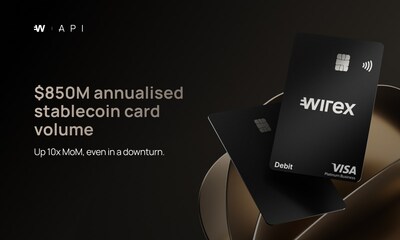
The achievement positions Wirex BaaS as one of the fastest-growing stablecoin payment infrastructures globally, driven by rapid adoption from fintechs, platforms, and ecosystem partners seeking production-grade onchain payment rails. Volume is fully transparent and publicly verifiable onchain: https://paymentscan.xyz/issuers/wirex
Despite broader crypto market downturns in February, a period during which many stablecoin providers experienced declining volumes, Wirex BaaS recorded 10x month-over-month growth.
The acceleration underscores both the structural demand for stablecoin-based payments and the scalability of Wirex's infrastructure. While some market participants struggled with liquidity fragmentation and scaling bottlenecks, Wirex BaaS expanded rapidly, processing increased throughput without disruption.
Pavel Matveev, Co-Founder of Wirex, said: "Reaching $850 million in annualised onchain volume within four months demonstrates the scale of demand for stablecoin payment infrastructure that actually works in production. The fact that we achieved 10x month-over-month growth during a market downturn confirms that this growth is driven by real usage, not market cycles. Stablecoins are entering their infrastructure phase, and the platforms that scale securely and transparently today will define the next generation of global payments."
Sustained growth during a downturn also highlights what stablecoin infrastructure needs to do well: handle higher transaction volumes while keeping payments fast and consistent - a core focus of Wirex BaaS.
What $850m annualised volume signals
The $850 million annualised figure reflects onchain payment activity executed through Wirex's stablecoin rails and associated payment flows. With transparent onchain visibility, the metric offers an auditable view into payment throughput - a key indicator for partners that require reliable execution rather than pilot-level volume.
For platforms building with stablecoins, scale is most meaningful when it comes with reliability under load, clear operational reporting, and the ability to deploy across markets without rebuilding infrastructure region by region.
Wirex BaaS provides a non-custodial stablecoin payment layer designed to connect blockchain-native settlement to traditional financial rails at global scale. The infrastructure supports:
- Stablecoin card issuance connected to global Visa and Mastercard rails
- 1:1 fiat–stablecoin conversion
- Cross-border payouts
- Push-to-card payments
- Embedded stablecoin banking infrastructure
Built for platforms, fintechs and enterprise partners, the stack is designed to support programmable payment logic while keeping settlement transparent and auditable.
Reaching $850 million annualised within four months, and accelerating during a market slowdown, points to an 'infrastructure phase' for stablecoins, where adoption is increasingly measured by payment throughput: spend, payouts, settlement and embedded finance. With volume transparently trackable onchain, stablecoin payment rails are moving from promise to measurable utility.
Learn more: https://wirexapp.com/agents
Developers: https://www.wirexapp.com/developers
About Wirex
Wirex is a global payments platform serving both consumers and businesses, offering card-based payment products alongside card issuance and banking infrastructure for partners. For end users, Wirex provides payment cards and banking features designed for everyday spending. For businesses, Wirex offers Banking-as-a-Service APIs, card issuance, and payment rails that enable digital platforms to launch compliant, globally accepted card programs. Trusted by over 7 million users since 2014, Wirex has processed $20 billion+ in transactions across 130 countries. As a principal Visa and Mastercard member, it makes crypto spendable anywhere — instantly and effortlessly.
Photo: https://mma.prnewswire.com/media/2926986/WIREX_BaaS.jpg
Logo: https://mma.prnewswire.com/media/2031625/5838250/Wirex_Logo.jpg

 View original content:https://www.prnewswire.co.uk/news-releases/wirex-stablecoin-card-volumes-jump-10x-surpass-850m-annualised-during-market-downturn-302705145.html