The Anime Effect: How Fans Are Travelling Across Asia for Real-World Experiences
- Anime culture drives travel as fans flock to real-world anime sites and festivals
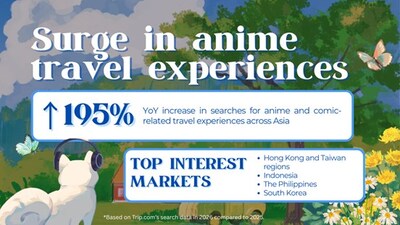
- 195% YoY surge in searches for anime and comic-related travel experiences across Asia
SINGAPORE, May 17, 2026 /PRNewswire/ -- Once considered a niche interest, anime and comics are now a global cultural force, with fans eager to venture beyond borders for immersive and connected experiences. From themed stays to global conventions, fans are embarking on anime pilgrimages, otherwise known as seichi junrei, creating a demand for anime tourism and travel across Asia.

Trip.com's latest data shows a growing demand for anime and comic-related experiences when travelling, with a 195% spike in searches for anime and comic-related travel experiences across Asia year-on-year (YoY). Interest comes predominantly from travellers in the Hong Kong and Taiwan regions, as well as Indonesia, the Philippines and South Korea[1].
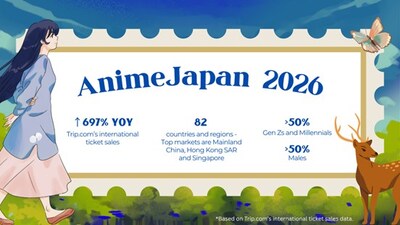
Most recently, as the exclusive overseas ticketing partner for one of the largest anime events - AnimeJapan 2026 in Tokyo - Trip.com's international ticket sales jumped 697% YoY. Travellers spanned across 82 countries and regions, with a large majority coming from Mainland China, Hong Kong SAR and Singapore. Highly popular among Gen Zs and Millennials, more than half of ticket buyers were aged between 25 to 34 years old, and over half were males[2].
Dominating Global Streaming Charts: Asia's Anime Revival
While anime has been around for a long time, social media and online streaming services have catapulted it into the screens of mainstream audiences. Anime series such as One Piece, Demon Slayer and Naruto have been dominating global streaming charts, gaining fans worldwide.
In fact, a report by Crunchyroll has shown that anime was rated favourably by 54% of Gen Z respondents, beating out popular celebrities like Bad Bunny, BLACKPINK and BTS. Even Formula 1 drivers are caught in the craze, such as Charles Leclerc and his love for Pokémon.
More than a passing trend, reports show that the demand for anime and comic-related content is growing exponentially, especially in Southeast Asia where there are many young and digitally native consumers. Markets like Indonesia, the Philippines and Thailand, are home to some of the most engaged fanbases globally.
Reel-life to Real-life Connection: Flying to Anime Conventions and Festivals
For many, anime culture is about being part of a shared community. Close to 8 in 10 anime fans felt that a shared love of the genre has helped them build or deepen friendships, based on a report by Crunchyroll. The report also found that the number one way fans engage with anime is by talking about it with friends, and more often in person than online, making global anime conventions and festivals the perfect opportunity for building connections.
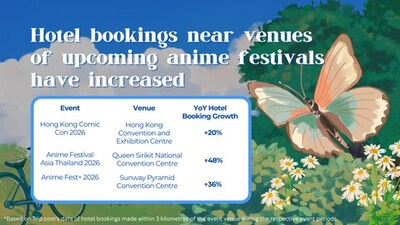
Trip.com's recent data found that hotel bookings made within 3 kilometres of upcoming anime festivals have increased during the duration of the event[3].
Hong Kong Comic Con 2026, in particular, has gained the attention of overseas fans from Mainland China and Southeast Asia. Over 8 in 10 ticket buyers are Gen Zs and Millennials, based on Trip.com's ticket sales data, demonstrating the popularity of anime culture among this age group. Interestingly, women constitute more than 80% of ticket sales, highlighting the genre's growing appeal among this audience group[4].
In Japan, major manga and anime events such as Comiket are held twice a year and attract a very dedicated fanbase. Odaiba, which will be home to Summer Comiket 2026 in August this year, is seeing a 78% YoY increase in hotel bookings during the event period[5]. Pokémon GO Fest 2026, a 10th anniversary celebration of the popular mobile game in Odaiba, is also trending on Trip.Pulse, Trip.com's data-powered list of the latest travel trends and hot topics, with over 630,000 views.
From Events to Immersive Travel Experiences
The influence of anime culture extends beyond event attendance to broader destination travel behaviour. Fans are increasingly visiting real-life locations that appear in anime, manga or related films. Reports have found that 70% of travellers across Asia are inspired to visit destinations based on what they have been watching, while a Japan Tourism Agency survey showed that foreign visitors to places associated with movies and anime increased from 4.6% in 2019 to 7.5% in 2023.
The railway crossing near Kamakura-Koko-mae Station, made famous by the popular basketball manga series Slam Dunk, has not only drawn local crowds, but also numerous overseas fans. Akihabara and Ikebukuro, known as meccas for otaku culture, has seen an average YoY increase of 10% in hotel bookings on Trip.com compared to the year before. Interest is primarily driven by travellers from South Korea, Thailand and Singapore, as well as the Hong Kong and Taiwan regions[6].

Beyond visiting these sites, fans and travellers today are also seeking a deeper and more immersive cultural experience, from their accommodation to the activities planned on the trip. For example, newly-launched themed glamping rooms at The Farm, a Japan country retreat, invite visitors to step into the fantasy world of Frieren, a popular anime and manga series, through physical photo spots and monuments throughout the campgrounds that recreate memorable scenes.
Universal Studio Japan, one of Trip.com's top-booked attractions in Asia this year, has also recently collaborated with five blockbuster franchises to bring a variety of anime experiences to visitors. This includes a new, immersive storywalk set in the world of Frieren: Beyond Journey's End, and three thrilling attractions based on Detective Conan: The World. Meanwhile, Trip.com offers a variety of curated tours that bring fans on an immersive journey through famous anime and manga sites, such as a Slam Dunk pilgrimage and Kamakura city day tour.
While entertainment continues to be a huge part of what influences people's identities and travel motivations, anime culture has become a global movement that goes beyond set-jetting, but a shared community across borders.
[1] Based on Trip.com's search data in 2026 compared to 2025. |
[2] Based on Trip.com's international ticket sales data. |
[3] Based on Trip.com Group's data of hotel bookings made within 3 kilometres of the event venue during the respective event periods. |
[4] Based on Trip.com's international ticket sales data. |
[5] Based on Trip.com's data of hotel bookings made in Odaiba from 14 to 17 August 2026, compared to the same period in 2025. |
[6] Based on Trip.com's data of hotel bookings made in Akihabara and Ikebukuro in 2026 compared to 2025. |
About Trip.com Group
Trip.com Group is a global travel service provider comprising of Trip.com, Ctrip, Skyscanner, and Qunar. Across its platforms, Trip.com Group helps travellers around the world make informed and cost-effective bookings for travel products and services and enables partners to connect their offerings with users through the aggregation of travel-related content and resources, and an advanced transaction platform consisting of apps, websites and 24/7 customer service centres. Founded in 1999 and listed on NASDAQ in 2003 and HKEX in 2021, Trip.com Group is on the mission "to pursue the perfect trip for a better world". Find out more about Trip.com Group here: group.trip.com.
Follow us on: X, Facebook, LinkedIn, and YouTube.

Photo - https://mma.prnewswire.com/media/2980953/1.jpg
Photo - https://mma.prnewswire.com/media/2980954/2.jpg
Photo - https://mma.prnewswire.com/media/2980955/3.jpg
Photo - https://mma.prnewswire.com/media/2980956/4.jpg
Photo - https://mma.prnewswire.com/media/2980920/5.jpg
Logo - https://mma.prnewswire.com/media/2919909/5972493/Trip_com_Group_Logo.jpg
 View original content:https://www.prnewswire.co.uk/news-releases/the-anime-effect-how-fans-are-travelling-across-asia-for-real-world-experiences-302773362.html