TCL Zhonghuan Launches Next-Generation BC Module at Tianjin Manufacturing Base
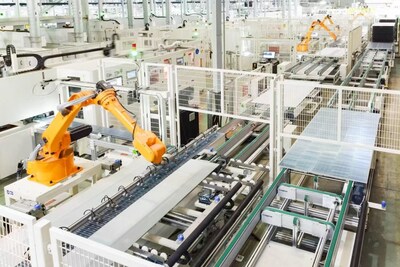
TIANJIN, China, May 25, 2026 /PRNewswire/ -- TCL Zhonghuan ("TCL Zhonghuan Renewable Energy Technology Co., Ltd.") announced the launch of its next-generation BC (back-contact) high-efficiency module at its Tianjin manufacturing base this month, marking a major milestone as the company transitions BC technology from advanced development into large-scale commercial production. Featuring a unique combination of proprietary BC architecture and in-house silicon wafer technology, the new module delivers up to 25.2% module efficiency and 680W power output, offering a high-performance solution for utility-scale and commercial & industrial (C&I) solar applications.
The launch further strengthens TCL Zhonghuan's position in next-generation PV technology and underscores its commitment to driving higher efficiency, greater reliability, and lower lifecycle energy costs across the solar industry.
Advancing BC Technology Through Integrated Innovation
Unlike conventional BC products available in the market, TCL Zhonghuan's BC platform is built on a fully integrated technology foundation spanning wafers, cells, and modules. The company's competitive advantages include a robust portfolio of more than 1,600 foundational BC patents, dedicated BC wafer development, and decades of research and manufacturing expertise.
The newly launched modules are manufactured using TCL Zhonghuan's proprietary high-efficiency silicon wafers. Based on the company's advanced low-carbon wafer technology platform, these wafers feature minority carrier lifetimes exceeding 1,000 μs, providing an ideal foundation for high-efficiency BC cell architectures. Combined with an optimized cell design, the technology supports conversion efficiencies exceeding 27% at the cell level while maintaining a temperature coefficient as low as -0.26%/°C.
To further enhance system reliability, TCL Zhonghuan has introduced a next-generation hotspot mitigation design that can reduce hotspot temperatures by up to 50°C compared with conventional modules. The modules also demonstrate excellent low-irradiance performance, with a weak-light response factor exceeding 95%, enabling stable energy generation under diverse operating conditions.
Setting a New Benchmark for High-Efficiency Modules
The new N-type BC modules combine TCL Zhonghuan's proprietary N-type wafer technology with advanced BC cell architecture, delivering strong performance across multiple dimensions.
With a mass-production efficiency of up to 25.2% and maximum power output reaching 680W, the modules are on par with mainstream BC products in terms of power rating. They incorporate enhanced resistance to fire risk, partial shading, and dust accumulation, while offering a 30-year linear power warranty and a 15-year product warranty.
The modules also achieve a bifaciality factor of 80% ± 5%, enabling higher rear-side energy generation and increased overall energy yield. Long-term reliability has been further strengthened through advanced PID-resistant design, limiting lifecycle power degradation to below 1% under testing conditions. The products have successfully passed rigorous certification and validation processes conducted by internationally recognized testing organizations.
In addition to performance advantages, the modules feature a busbar-free front surface that creates a clean, all-black appearance, making them particularly suitable for BIPV and premium rooftop applications. Their versatility also allows deployment across utility-scale, commercial, and distributed generation projects, helping customers reduce LCOE and maximize long-term project value.
Reinforcing Leadership in BC Technology
As an early pioneer and long-term innovator in BC technology, TCL Zhonghuan has leveraged more than four decades of semiconductor materials expertise and extensive photovoltaic manufacturing experience to establish a distinctive BC technology platform. By combining advanced BC cell architecture with proprietary strengths in large-format wafers, N-type materials, and intelligent manufacturing, the company has created a vertically integrated innovation ecosystem that accelerates technology commercialization and performance improvement.
TCL Zhonghuan possesses one of the industry's most comprehensive BC intellectual property portfolios. Since achieving the world's first commercial-scale production of IBC cells in 2004, the company has continued to expand its innovation footprint, securing more than 1,600 globally authorized BC patents covering crystal growth, cell structures, manufacturing processes, and module packaging technologies.
As global demand for high-efficiency solar solutions continues to grow, TCL Zhonghuan remains committed to advancing solar innovation through continuous technology development and manufacturing excellence. Working closely with customers and industry partners worldwide, the company will continue to accelerate the adoption of next-generation PV technologies and contribute to a more sustainable, low-carbon energy future.
Photo - https://mma.prnewswire.com/media/2986980/image1.jpg
 View original content:https://www.prnewswire.co.uk/news-releases/tcl-zhonghuan-launches-next-generation-bc-module-at-tianjin-manufacturing-base-302781197.html