Segway Navimow sets the industry standard as the World's No. 1 brand in wire-free robotic lawn mower retail volume sales for two consecutive years
Over 400,000 users worldwide maintain their gardens with Navimow's wire-free robotic lawn mowers, as homeowners increasingly turn to smarter, hassle-free solutions to reclaim their time outdoors.
BERLIN, April 20, 2026 /PRNewswire/ -- Navimow, a leader in the intelligent robotic lawnmower market, has officially been recognized as the World's No. 1 Brand in Wire-Free Robotic Lawn Mower Retail Volume Sales for two consecutive years*. The milestone underscores not only commercial success but a fundamental shift in how homeowners care for their outdoor spaces.
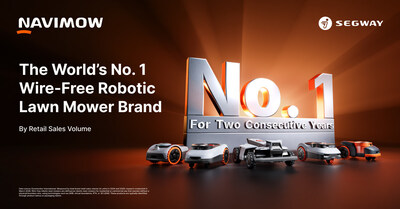
Britons, long accustomed to the limitations of traditional boundary wires and labor-intensive mowing, are embracing a new generation of intelligent lawn care. From complex garden layouts to unpredictable weather, the demand for reliable, autonomous solutions has never been greater.
According to George Ren, CEO at Segway Navimow, the shift is being driven by a new standard in innovation and performance. "Navimow has redefined what homeowners should expect from robotic lawn care," Ren explains. "Being recognized as the world's No.1 brand in wire-free robotic lawn mower retail volume sales for two consecutive years reflects our commitment to making lawn care truly effortless."
At the heart of this leadership is Navimow's pioneering technology. Its fully wire-free setup eliminates the need for cumbersome boundary installation. Additionally, the all-wheel-drive models provide exceptional mobility across all terrains, while TÜV Rheinland certified "Lawn Care" ** standards ensure precision and turf protection. Advanced EFLS™ LiDAR⁺ , powered by AI triple-fusion positioning, works alongside GeoSketch™ 3D mapping to enable accurate navigation even in the most complex gardens.
This focus on innovation is matched by sustained market leadership. Navimow has secured the top position in global retail sales volume for wire-free robotic lawn mowers for two consecutive years, underlining its growing dominance in the category.
"Homeowners don't want complexity—they want results. That's why strong word-of-mouth among our users has helped drive our No. 1 sales position," Ren continues. "At Navimow, we believe that advanced technology should simplify everyday life, not complicate it. Our team will continue to push the boundaries of what's possible in outdoor robotics, ensuring that every garden, no matter how complex, can be maintained effortlessly."
The brand's credibility is further reinforced by widespread adoption and independent recognition. With a userbase of over 400,000 globally, Navimow products are also consistently ranked highly in rigorous media testing by leading publications, as well as achieving top comprehensive evaluations from leading testing bodies.
Across its product range, Navimow continues to push boundaries. Models such as the X4 and i2 AWD feature TÜV Rheinland "Lawn Care" certification, with the i2 AWD standing out as the market's only three-wheel all-wheel-drive model with this official backing. The i2 LiDAR series delivers a true "Drop & Mow" experience straight out of the box, while i2 LiDAR Pro variant tackles extreme slopes with ease. Meanwhile, the H2 model introduces high-resolution solid-state radar, ensuring ultra-stable performance even in the most challenging environments.
To meet this growing demand, Navimow is now highly accessible across all major sales channels. The brand has expanded its presence through specialist dealer shops, major online marketplaces, and mainstream DIY stores across key regions.
*Data source: Euromonitor International, measured in terms of total brand retail sales volume in units in 2024 and 2025 respectively; based on research conducted in 2026. Wireless boundary robotic lawnmower is defined as robot lawn mower, used for both residential and commercial applications, that operates without the need for a physical boundary wire to navigate the lawn or field, by adopting technologies such as UWB, Virtual, RTK, 3D Lidar, etc., and typically identified in product name or claim on packaging.
**Disclaimer: Data is sourced from TÜV Rheinland certification reports (X420: Certificate Q 50714188 0001 / Report CN26DPDC 001; i2 AWD: Certificate Q 50714192 0001 / Report CN263HAU 001). The tests used an accelerated ageing model to simulate high-frequency residential usage scenarios for European users over a calendar year (calculated based on mowing twice a week for 10 months), with the environment including common obstacles such as tables, chairs, water pipes, electrical wires, and toys. The X420 operated normally at a slope of 57.7% (30°) and the i206 AWD at a slope of 47.6% (25°), achieving the "Minimum Lawn Impact Level." This level refers to TÜV Rheinland's Level 2 standard, meaning only extremely minor, localised traces (visible damage count ≤1), not affecting the overall aesthetics and health of the lawn, and only visible upon close inspection. Actual results may vary depending on lawn condition and environment.
About Segway Navimow
Segway Navimow is a subsidiary of Ninebot Limited (Stock Code: 689009). As a high-tech enterprise dedicated to the research, development, manufacturing, and sales of intelligent service robots, the company is committed to integrating next-generation innovations into everyday life. Its vision is to build Navimow into the world's premier brand of wire-free intelligent robotic lawn mowers.
The brand's product portfolio includes a full lineup of models, featuring the i Series, H Series, X Series, and the commercial-grade Terranox Series. This comprehensive range is designed to meet the needs of customers with different lawn sizes and usage scenarios.
Segway Navimow is a leading brand in the global robotic lawn mower market. To date, our products are available in more than 40 countries and regions worldwide, including Europe, North America, and Australia, serving more than 400,000 families.
Photo - https://mma.prnewswire.com/media/2960019/20260420_100029.jpg
 View original content: