Park Place Technologies' New AI-Powered Platform Provides Full View of IT Infrastructure Health
AI platform scores every server, storage and network device from 0 to 100, giving IT teams OEM-level data to decide whether to refresh, repair or retire equipment.
CLEVELAND, Sept. 30, 2026 /PRNewswire/ -- ParkView Asset Intelligence, an AI-powered platform that shows IT managers the health of their infrastructure and insights to act on it, launched today from Park Place Technologies.
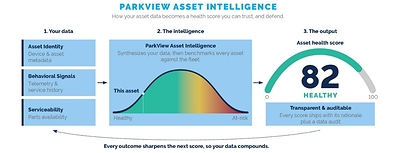
Called ParkView Asset IntelligenceTM, the new proprietary platform provides a detailed view into the condition of hardware devices, including servers, storage, network, security appliances and hyperconverged infrastructure, at a level previously only accessible to original equipment manufacturers (OEMs).
"ParkView Asset Intelligence is able to provide the insights, previously only visible to OEMs, to our customers and business partners – empowering them to make the most informed asset and financial decisions for their enterprises," said Chris Adams, CEO, Park Place Technologies. "Significant resources have been dedicated to its development."
Each lifecycle health score, expressed as a 0 to 100 rating, is built from three streams of data – Park Place's own hardware maintenance records, spanning more than 35 years and a million serviced assets across every major manufacturer; regional spare-parts availability; and customers' own asset performance and service history.
A score of 66 means something very different once a team can see that comparable devices in the same model family average 92, Adams gave as an example. The result is designed to help experienced IT teams decide whether to refresh, repair or retire a specific piece of hardware.
Paul Bevan, Research Director, IT Infrastructure for independent industry analyst firm Bloor Research said "In reality, it is at the same time both prosaic but, potentially, hugely impactful. What Park Place Technologies has done is to build an intelligence system on top of the huge amount of data that ParkView holds about the health, performance, and lifecycle of every asset in a customer's environment, helping make maintenance and refresh decisions planned, not reactive."
What ParkView Asset Intelligence Does
The platform combines hardware telemetry, Park Place's service history and live supply-chain data into a single view of fleet health:
- Scores every asset, 0 to 100 – Hardware-level data is collected out-of-band from enrolled assets, independent of the operating system, so scoring continues even when the OS is unreachable. Each score is paired with a confidence indicator.
- Reads failure patterns no single customer can see – Park Place service records across nearly one million of hardware assets reveal how specific models fail, and at what age. No individual enterprise runs a fleet large enough to detect those patterns on its own.
- Factors in whether parts actually exist – data on spare-part stock by geography feeds directly into the score, so an asset's supportability in its own region is part of the reading rather than a separate calculation.
- Surfaces risk before it becomes a failure – Configuration problems, firmware gaps and deteriorating component trends move the score before they generate a support ticket.
- Benchmarks against the peer group – Every score is set against aggregated data from comparable devices across Park Place's global customer base, showing whether an asset is performing above or below the expected range for its model.
- Rolls up to the whole fleet – A portfolio dashboard breaks health scores out by OEM, product family and location, making it possible to spot trends across thousands of assets and concentrate attention where it matters most.
For organizations running hardware past OEM support on a third-party maintenance contract, the scores supply the documented evidence needed to justify that decision internally — or the early warning needed to act before a failure forces the issue.
"IT managers using ParkView Asset Intelligence gain visibility not just into their own assets' data, but into how those assets compare to thousands of similar devices at every stage of the lifecycle," said Daniel Nelson, Chief Product Officer, Park Place Technologies. "We can now give users an objective, data-driven picture of where their infrastructure stands, and help them anticipate what to do next.
"For example, data across hundreds of thousands of device health assessments from multiple tier-1 OEMs reveals that about 1 in 50 devices today have been identified as high risk, indicating a change is needed. The insights gathered from those devices help ParkView Asset Intelligence customers to take action on their lifecycle decisions faster and avoid a break that causes prolonged downtime."
Availability
The beta version of ParkView Asset Intelligence is available now to all existing Park Place customers and will close on October 31. New customers of Park Place can receive the full version of ParkView Asset Intelligence immediately.
For more information about ParkView Asset Intelligence, visit https://www.parkplacetechnologies.com/parkview-asset-intelligence/.
About Park Place Technologies
Park Place Technologies is a leading global IT infrastructure services firm with $1.2 billion in annual revenue and 3,000+ employees. We help 25,000+ organizations in 180 countries – including half the Fortune 500 – fuel innovation by dramatically reducing time and money spent on IT infrastructure management, while boosting performance and uptime.
Powered by the world's largest on-the-ground engineering team, a robust group of advanced engineers, and our global Enterprise Operations Centers, Park Place delivers significant cost savings on hardware maintenance, software technical support, hardware procurement, and more. We also streamline IT infrastructure management, freeing internal teams from day-to-day tasks, enabling them to focus on strategic initiatives.
For more information, visit ParkPlaceTechnologies.com.
ParkView Asset Intelligence is a trademark of Park Place Technologies. All other product names are the property of their respective owners.

 View original content to download multimedia:https://www.prnewswire.co.uk/news-releases/park-place-technologies-new-ai-powered-platform-provides-full-view-of-it-infrastructure-health-302894336.html