Meshy Debuts New In-House AI Model with Meshy Edit, Letting Users Change Selected Parts of a 3D Model with One Prompt
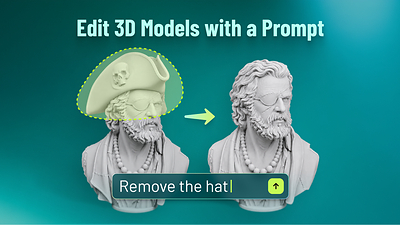
Meshy Edit changes only the selected part and leaves the rest of the model as it is.
SILICON VALLEY, Calif., Oct. 16, 2026 /PRNewswire/ -- Meshy, an AI 3D multimodal model company, today launched Meshy Edit. Users select the area of a 3D model they want to change, describe the edit in plain language and get a new model in about a minute. Meshy Edit leaves the rest of the model as it is. It runs on a new model built in-house by Meshy and is available now to all registered users.
Once a 3D model is generated, creators often want to take it further: remove an accessory, add a detail or try a different shape for one part. Until now, making that kind of change meant regenerating the whole model, which also changes the parts they wanted to keep, or editing the mesh by hand in professional software such as Blender, which requires solid modeling skills.
Meshy Edit splits an edit into two steps: select, then describe. With the Lasso tool, users circle a whole part on screen, and the selection covers the front, sides and back of the model. With the Brush tool, they paint over visible surfaces to refine the edge of the selection. The description can be a single sentence, such as "remove the hat," and users can add up to five reference images. Without a selection, the edit applies to the whole model.
Each edit creates a new model and keeps the original. The new model can be edited again, downloaded or sent directly to slicer software, which prepares models for 3D printing.
Meshy Edit is built for two groups in particular. 3D printing users who make figurines, tabletop miniatures, designer toys or merchandise can remove or add parts, or swap accessories, then print. Game developers and character artists can keep a finished character as it is and change only a prop or an accessory to create several versions of the same character quickly.
Consumer spending on Meshy is already visible in third-party data. On October 5, a16z released the seventh edition of its Top 100 Gen AI Consumer Apps report and, for the first time, added a ranking of the top 50 consumer AI apps by monthly revenue. The ranking is based on observed U.S. consumer card spending from YipitData and reflects what consumers actually pay. Meshy placed 31st, alongside creative tools such as Midjourney, Suno and Runway, and is the only AI 3D company on the list.
For paying users, time is the most direct cost. Changing a single detail by hand in Blender can take hours. With Meshy Edit, it takes minutes. Creators keep what already works and spend their effort on the details they care about.
Pricing and Availability
Meshy Edit is available now to all registered Meshy users. Each edit costs 20 credits. It works on high-poly models generated with Meshy 6 and Meshy 7.1; textured models switch automatically to their untextured version for editing. Users can open Meshy Edit from the model viewer and from Meshy's 3D printing tools.
Frequently Asked Questions
What is Meshy Edit?
Meshy Edit is a 3D model editing feature from Meshy, an AI 3D multimodal model company. Users select part of a 3D model, describe the change in plain language and get a new model in about a minute, while the rest of the model stays as it is. Meshy Edit launched on October 16, 2026, and runs on a new model built in-house by Meshy.
How do I edit only part of a 3D model with AI?
In Meshy Edit, users circle the area they want to change with the Lasso tool or paint over it with the Brush tool, then type a prompt such as "remove the hat." Up to five reference images can be added. Without a selection, the edit applies to the whole model. Every edit creates a new model and keeps the original.
Can I change part of an AI-generated 3D model without using Blender?
Yes. With Meshy Edit, users can remove or add parts, or swap accessories on a Meshy-generated model with a text prompt. Changing a single detail by hand in Blender can take hours. With Meshy Edit, it takes minutes.
How much does Meshy Edit cost, and who can use it?
Meshy Edit is available to all registered Meshy users. Each edit costs 20 credits and usually takes about one minute.
Which 3D models does Meshy Edit support?
Meshy Edit supports high-poly models generated with Meshy 6 and Meshy 7.1, including Ultra 2K models. Textured models switch automatically to their untextured version for editing. Ultra 4K models, low-poly models and uploaded models are not supported yet.
Can I 3D print a model after editing it with Meshy Edit?
Yes. A model edited with Meshy Edit can be downloaded or sent directly from Meshy to slicer software such as Bambu Studio, Snapmaker, Flash Studio and xTool Studio.
About Meshy
Meshy is an AI 3D multimodal model company. Founded by Ethan Hu, who holds a Ph.D. from MIT, Meshy builds foundation models for AI-powered 3D generation, turning text and images into ready-to-use 3D assets for games, film and 3D printing. Meshy serves more than 15 million registered users and over 3,000 companies and educational institutions worldwide. In July 2026, the company raised nearly $400 million in a Series B round at a $1.5 billion valuation, the largest round to date in AI 3D. In September 2026, Meshy became the first AI 3D company to surpass $100 million in annual recurring revenue (ARR). Learn more at meshy.ai.
 View original content to download multimedia:https://www.prnewswire.co.uk/news-releases/meshy-debuts-new-in-house-ai-model-with-meshy-edit-letting-users-change-selected-parts-of-a-3d-model-with-one-prompt-302911274.html