Market Logic's DeepSights MCP scales market insights reach and business impact through enterprise-wide AI workflows
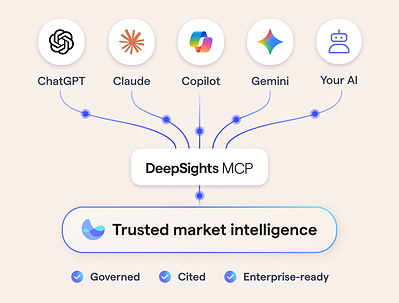
DeepSights MCP, now generally available, connects an expert market intelligence AI to Microsoft Copilot, ChatGPT, Claude and custom agents, so everyday AI work draws on accurate, cited market evidence
BERLIN, Oct. 7, 2026 /PRNewswire/ -- Market Logic Software, the company behind DeepSights. the leading AI market intelligence platform, today announced the general availability of DeepSights MCP. The Model Context Protocol (MCP) connection makes DeepSights the expert source that enterprise AI assistants and agents consult whenever a question depends on knowledge of the market. It extends the reach of each customer's curated market knowledge from the insights team to every employee and every AI workflow in the business.
Large organizations invest tens of millions every year in consumer and market research. The return on that investment depends on how widely, and how often, the resulting insights shape business decisions. Connecting trusted market intelligence to the rapid spread of enterprise AI assistants, from Microsoft Copilot to ChatGPT and Claude, creates a golden opportunity to extend insights impact to a new level.
Once the DeepSights MCP is in place, AI assistants call on DeepSights as a matter of course to answer questions about customers, categories and competitors. Similarly, automated, multi-step workflows proactively draw expert input on market from DeepSights before handing off to other agents to complete tasks.
The connection also addresses the growing risk of business decisions being fed by incomplete or misleading information by generic AIs rather than specialized AI. DeepSights works the way an insights expert does to provide an accurate, evidence-backed view of the market. It analyzes information proactively, separating what is relevant from noise. DeepSights works only on trusted data and cites its references in every answer.
"Your AI knows your company. DeepSights knows your market," said Olaf Lenzmann, Chief Innovation and Product Officer at Market Logic. "Our customers have spent years and significant budgets building a unique understanding of their consumers and markets. Adding DeepSights at the market intelligence layer for enterprise AI ensures that competitive advantage is seized on and integral to decision making processes. The DeepSights MCP will make it easier than ever for trusted, evidence-backed market intelligence to flow freely through the organization."
Establishing DeepSights as the trusted market intelligence layer for all AI workflows also gives insights and IT teams one central way to govern and secure the knowledge that creates their unique market understanding. Insights team continues to decide which sources are trusted. User permissions in DeepSights controlling which sources an individual has access to are carried through by the MCP into information shared through other AI assistants. Because the connection is built on the open Model Context Protocol (MCP), the same governed layer serves every assistant and agent the company adopts.
DeepSights MCP is generally available to DeepSights customers today. It works with Microsoft Copilot, ChatGPT, Claude, Glean and other assistants and agents that support the Model Context Protocol. For more information, visit www.marketlogicsoftware.com.
About Market Logic Software
Market Logic Software is a provider of pioneering market intelligence and insights solutions. Its AI-enabled platform, DeepSights, helps organizations make research and market intelligence available to decisionmakers across the enterprise at scale and speed. For more than 15 years, Market Logic has worked with consumer-focused brands around the world to support insights-driven decision-making. Customers include Vodafone, Bayer and Philips. More information is available at https://marketlogicsoftware.com.

 View original content to download multimedia:https://www.prnewswire.co.uk/news-releases/market-logics-deepsights-mcp-scales-market-insights-reach-and-business-impact-through-enterprise-wide-ai-workflows-302899947.html