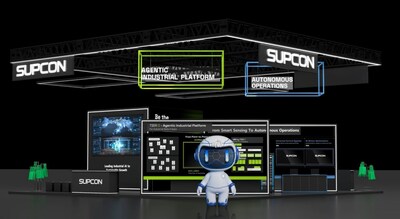
From Automation to Autonomy: SUPCON to showcase next-generation technologies empowering Autonomous Operating Plants at Hannover Messe 2026
SINGAPORE, April 13, 2026 /PRNewswire/ -- SUPCON (688777.SH, SUPCON.SW) is a global leader in industrial automation and industrial artificial intelligence. Experience the future of smart industries at Hannover Messe 2026 (April 20–24) where SUPCON will showcase next-generation technologies empowering autonomous operating plants, from Advanced Physical Layer (APL) instrumentation to Online Analyzers, from Software-defined control systems to Unified Namespace (UNS) data platform and Industrial AI large models, SUPCON's portfolio of products and solutions are designed to transition industrial facilities from automated to autonomous operations.
As global industries face mounting pressure to improve efficiency and resilience, there is a pressing need to embrace technologies enabling the shift from traditional automation to systems capable of autonomous operations.
The exhibit features six integrated technological pillars:
1. Universal Control Systems (UCS): SUPCON's Universal Control System (UCS) is a next-generation, software-defined control system that decouples control functions from proprietary hardware. By eliminating traditional control cabinets and leveraging cloud-native architecture, UCS reduces physical footprint while enhancing system flexibility, scalability, and readiness for autonomous operations.
2. TPT2 Universal AI Platform: SUPCON's TPT2 (Time-series Pre-trained Transformer) is a large-scale industrial AI platform designed to understand and model complex time-series process data. By enabling closed-loop AI optimization (AIO), TPT2 allows plants to analyze, predict, and autonomously execute operational decisions in real time.
3. Tier0 Industrial Data Platform: SUPCON's Tier0 platform is a cloud-native industrial data platform built on a Unified Namespace (UNS) architecture. It enables seamless data integration, contextualization, and application development, allowing organizations to transform fragmented data sources into scalable, reusable industrial applications with reduced integration complexity.
4. Advanced Physical Layer (APL): SUPCON's APL solutions harness Ethernet-APL to deliver high-speed, reliable, and intrinsically safe communication from field devices to control systems. This foundational connectivity enables real-time data access, supporting advanced applications such as predictive analytics and digital twins.
5. Autonomous Industrial Robots: SUPCON's industrial robotics solutions are designed to augment plant operations with autonomous capabilities. By combining mobile robotics, advanced sensing, and a centralized robot management platform, these solutions enable real-time inspection, monitoring, and intervention, forming a key component of an autonomous workforce.
6. Hobré Intelligent Analyzers: Hobré intelligent analyzers deliver advanced, real-time gas analysis for the energy and chemical industries. Designed for high accuracy and reliability in harsh environments, these analyzers enable continuous measurement, supporting closed-loop optimization, faster decision-making, and improved process efficiency while minimizing reliance on manual sampling.
Visit SUPCON at Hannover Messe 2026:
"Hannover Messe is where global innovation meets real-world industrial transformation," said Mercy Zhang, VP of R&D at SUPCON International Business. "We are moving beyond simply providing traditional autonomation to defining a transformational roadmap to Autonomous Plants and Agentic Operations. By unifying advanced sensing technologies with software-defined controls, industrial data platforms and large industrial AI models trained on real-world datasets, we are empowering our customers to achieve unprecedented levels of autonomy."
- Dates: April 20–24, 2026
- Location: Hall 16, Booth B16
- Experience: Live demonstrations and expert-led technical sessions
- Showcase: SUPCON's products and solutions in Hannover Messe (YouTube Link)
Register HERE for complimentary visitor passes and more information on the future of autonomous operating plants and industrial intelligence.
About SUPCON
SUPCON (688777.SH, SUPCON.SW) is a global provider of industrial automation and industrial AI, offering control systems, digital platforms, robotics, and software solutions that power the world's process and energy industries. Headquartered in Hangzhou, China, with the SUPCON Internal Business Headquarters in Singapore and the regional hubs around the globe, SUPCON is well-positioned to elevate industrial intelligence and drive customer success. Trusted by more than 250 leading enterprises and 39,000+ customers worldwide across major process industries such as oil & gas, chemical and petrochemical, as well as other industries such as power, pulp and paper, building materials, and more, SUPCON is driving the evolution from automation to autonomy—enabling safer, smarter, and more sustainable industrial operations.
For more information, please visit https://global.supcon.com/
Media Contact:
Kenneth Lim, Strategy and Marketing Director
SUPCON International Business Pte Ltd
kenneth@global.supcon.com
Photo - https://mma.prnewswire.com/media/2954510/SUPCON_Booth_annover_Messe_2026.jpg
 View original content:https://www.prnewswire.co.uk/news-releases/from-automation-to-autonomy-supcon-to-showcase-next-generation-technologies-empowering-autonomous-operating-plants-at-hannover-messe-2026-302740243.html