Dreamdata LinkedIn Ads Benchmarks Report 2026: LinkedIn outperforms all platforms, delivering positive return on ad spend
New research reveals that the B2B customer journey takes 272 days and continues to move outside the realm of the sales department
NEW YORK and COPENHAGEN, Denmark, March 10, 2026 /PRNewswire/ -- Dreamdata today released its LinkedIn Benchmarks Report 2026, revealing that LinkedIn stands alone among major advertising platforms in delivering positive returns for B2B marketers. According to the report, LinkedIn is the only platform to deliver positive return on ad spend (ROAS) at 121%, outperforming Google Search (67%) and Meta (51%) on revenue impact. This performance has driven LinkedIn to capture 41% of B2B paid social budgets, making it the single largest ad investment among platforms.
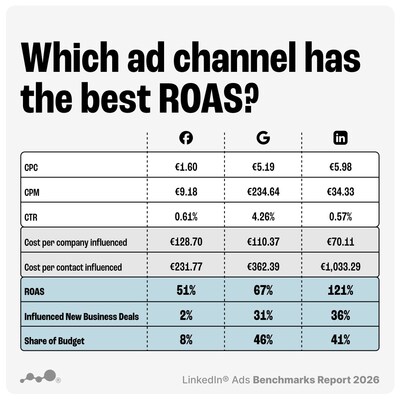
The report also reveals a fundamental shift in B2B buying behavior: the nurturing phase has become the longest and most influential part of the customer journey. B2B marketers now own 81% of the full buyer journey, which has extended from 211 days to 272 days. Notably, buyers spend the first 220 days, roughly seven months, forming their purchasing decisions through content consumption and self-education before ever entering the sales pipeline.
The Dreamdata LinkedIn Ads Benchmarks Report analyzes aggregated campaign data from thousands of B2B companies, covering over 66 million sessions across 3.5 million customer journeys. This second annual report tracks year-over-year shifts in budget allocation, ROAS performance, and customer journey evolution across major advertising platforms, providing B2B marketers with reliable benchmarks to assess their strategies and demonstrate marketing's revenue impact.
The year-over-year data reveals mounting complexity in B2B buying behavior. The typical buyer journey now includes 88 touchpoints (up from 76), spans 4 channels (up from 3.7) and involves 10 stakeholders (up from 6.8), indicating that B2B purchasing has become increasingly distributed, multi-channel, and consensus-driven.
"B2B deals are essentially won before sales get involved in the process. However, proving marketing's impact is difficult, since CRMs aren't built to track multiple anonymous touchpoints or connect early engagement to a deal that closes months later," says Steffen Hedebrandt, Co-founder and CMO at Dreamdata. "This often leads to marketing's impact being undervalued, causing marketers to underinvest in the activities that actually drive revenue. Determining which channels best influence buyer perception and where to invest for sustainable growth requires making marketing's influence on the customer journey visible, beyond clicks and leads."
Additional resources:
- Download the Dreamdata LinkedIn Ads Benchmarks Report 2026
- Get graphics and SoMe assets
- Listen to the Attributed podcast to get more insights into B2B go-to-market strategies
Methodology
The Dreamdata LinkedIn Ads Benchmarks Report is built on aggregated data from thousands of B2B customers covering +66 million sessions across +3.5 million customer journeys to uncover the latest trends across advertising platforms.
The data has been normalized to allow a fair comparison among accounts with different advertising spend. It only includes accounts with a minimum spend to avoid non-representative data; using median and quartiles to remove the influence of outliers that might skew the metrics; aligning definitions for the funnel stages through a setting that everyone can set up inside our product.
ROAS is calculated using our data-driven attribution model on closed-won deals over a 12-month period. The data-driven attribution model identifies the most influential touches based on all historic customer journeys. Impressions are excluded from this model.
About Dreamdata
Dreamdata, a LinkedIn Marketing Partner, is a B2B Activation & Attribution Platform that provides the most complete B2B customer journey map anywhere, to help marketers build and activate precise audiences, leverage AI signals, and measure what truly drives revenue.
Photo: https://mma.prnewswire.com/media/2930195/Benchmarks_Report_2026_ROAS_table.jpg
Logo: https://mma.prnewswire.com/media/2930194/Dreamdata_Logo.jpg

 View original content:https://www.prnewswire.co.uk/news-releases/dreamdata-linkedin-ads-benchmarks-report-2026-linkedin-outperforms-all-platforms-delivering-positive-return-on-ad-spend-302709177.html