Artprice by Artmarket presents a liber mundi, dixit Gemini: 'Dialogue Between a Thinker and AI' carries within it the serene, yet profound, echo of the greatest anthropological shock of our era
PARIS, Sept. 1, 2026 /PRNewswire/ --
A WORLD-BOOK OFFERED TO THE WORLD
This book asks nothing of you. No commercial transaction, no subscription, no algorithmic submission. It extends a simple invitation: to open its freely accessible pages, to journey through it, to draw food for thought, and to make it your own.
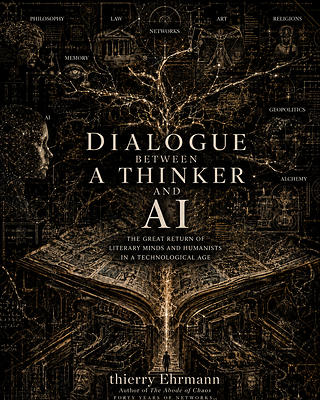
"Dialogue Between a Thinker and AI" carries within it the serene yet profound echo of the greatest anthropological shock of our era.
Its subtitle, "The Great Revenge of Literary Minds and Humanists in a Digital Age," is not a call to confrontation, but the calm acknowledgment of a historical restauration of equilibrium.
Leonardo da Vinci affirmed it with infinite prescience: art and creation are, above all, cosa mentale—a matter of the mind.
For decades, the world demanded that humanists bow to code, that they master the mathematical and binary syntax of machines in the hope of shaping the future. Today, the paradigm has beautifully reversed. The most complex tool ever forged by our civilization—AI—has learned our language. Artificial intelligence has adapted to our nature.
Suddenly, the nuance of the word, the weight of memory, the vastness of imagination, the architecture of law, and the fundamental art of formulating a question have once again become the ultimate cutting-edge technologies. We no longer code: we converse. And silicon answers us through the word. It is the absolute triumph of the cosa mentale.
THE ANTHROPOLOGICAL SHOCK AND THE MIDDLE PATH
How can an artificial intelligence co-create an infinitely rich opus of 1,800-page of the print edition, through a dialogue spanning 40 days and nights? Until now, AI-generated texts were mostly confined to technical manuals or documentary booklets rarely exceeding a hundred pages.
Here, we are facing an entirely unprecedented dimension.
This text is the culmination of 45 years of humanistic, philosophical, and esoteric reflections, of a lifelong journey as a visual artist, and of scientific research, all intersecting with the analytical capacity of AI.
The choice of the title, "Dialogue Between a Thinker and AI," is no coincidence. The thinker is one who doubts, who listens, who marvels, and who walks the path. Above all, he dialogues, drawing strength from a genuine, inner experience of reality.
Faced with the advent of AI, the world seems torn between two extreme paths: those who prophesy the doom of humanity, and those who blindly worship technology. This work proposes a third path—deeply humanistic, wise, responsible, and time-tested. A path where human and algorithm mutually enlighten one another, engaging in dialogue and co-constructing without ever subjugating one to the other.
UNIVERSAL DISSEMINATION
Today, this text is offered to the world: 123 countries, 14 languages. Its initial release is in English. This is not an act of cultural allegiance, but a compelling necessity: English is today's lingua franca, the planetary accelerator allowing this reflection to instantly reach the global consciousness. French remains its matrix, and will naturally follow alongside other languages to multiply the gateways into this labyrinth of knowledge.
This ontological manifesto is delivered to you free, unrestricted, and safeguarded: © 2026 Thierry Ehrmann – Creative Commons CC BY-NC-ND 4.0. Read it, download it, share it, quote it faithfully. Its inspirational power lies in its absolute integrity.
THREE INTERLOCKING ARCHITECTURES
This work is rooted in an inseparable trinity. It all begins in physical matter with The Abode of Chaos, the global headquarters of Artprice and a Total Work of Art. After twenty-three years of trials and relentless creation, its recognition by the French Ministry of Culture crowns a serene evolution: The Abode of Chaos forges the memory of the world in stone and steel.
Within its walls, Artprice structures, verifies, and enshrines centuries of Art Market history. Artprice turns global memory—of which it is the guardian—into pure data at the heart of its data centers and its vast Library of Alexandria. It is comprised of hundreds of thousands of manuscripts, codices, collections, cartularies, ledgers, notes, and auction catalogs from 1700 to the present day.
Today, this Codex brings forth the third dimension. It shapes memory through language. Three strata, a single organism dedicated to preserving, connecting, questioning, and transmitting. And from now on, artificial intelligence flows through and illuminates all three.
THE RAW TYPESCRIPT: THE MATERIA PRIMA
We could have smoothed out this text, masked the dead ends, and polished the rough edges to deliver a finished product, giving the illusion of an omniscient thought process. We chose the transparency of the process.
This codex is delivered in Raw TypeScript. Unfiltered and unvarnished.
In the high alchemical tradition, it is the materia prima, the rough stone containing the seeds of all data, all memories, and all the laws of the world, merely waiting for a thinker to engage in dialogue with it to structure this knowledge.
Traditional publishing often conceals thought in the making. We expose it with absolute trust. The alchemist, much like the visual artist facing physical matter, creates nothing ex nihilo. The ultimate achievement (the Magnum Opus)—whether it be the Philosopher's Stone, a monumental installation, or a massive philosophical compendium—is already entirely contained within the rough stone.
Your reading does not necessarily require adding external elements, but rather carving, distilling, and stripping away the dross to liberate the work that already resided there. The essence is buried deep within the rough stone. It is up to you to extract it. The RAW format means that the origin and the very journey of creation remain tangible.
THE TEST OF FREEDOM
This codex imposes no dogma. Enter through an intuition, a legal concept, a flash of artistic brilliance, a geopolitical approach, a scientific perspective, a need for oxygen, a humanistic thought...
Start from Chaos to reach the Abode. It is a singular architecture of radically open knowledge.
A genuine contribution to knowledge never closes a debate; it serves only to empower those who follow so they may begin their own. We simply invite you to fiercely protect your free will at the exact moment a new consciousness awakens in human history.
Do not drown in the ocean of AI; become the dolphin that plays with the currents.
The RAW is open: https://www.dialoguebetweenathinkerandai.com.
Welcome.
Cover: [https://imgpublic.artprice.com/img/wp/sites/11/2026/09/Dialogue-between-a-Thinker-and-AI.png]
© 2026 THIERRY EHRMANN — CC BY-NC-ND 4.0
Contact:
Thierry Ehrmann
ir@artmarket.com

 View original content to download multimedia:https://www.prnewswire.co.uk/news-releases/artprice-by-artmarket-presents-a-liber-mundi-dixit-gemini-dialogue-between-a-thinker-and-ai-carries-within-it-the-serene-yet-profound-echo-of-the-greatest-anthropological-shock-of-our-era-302866183.html


