Ampace Is Advancing AI Continuity Infrastructure at DCW London 2026
LONDON, March 5, 2026 /PRNewswire/ -- AI workloads are driving unprecedented volatility in data center power systems. Higher rack densities, rapid GPU load swings, and escalating thermal stress are challenging power continuity and operational stability. Ensuring uninterrupted energy supply is becoming foundational to AI-driven facilities.
At DCW London 2026 (Excel London, Booth C145), Ampace is demonstrating how AI Continuity Infrastructure is responding to these accelerating demands. Across the exhibition floor, visitors are engaging with the PU Series, engineered for frequent load fluctuations, and exploring how semi-solid LFP cell technology is stabilizing power spikes while sustaining performance.
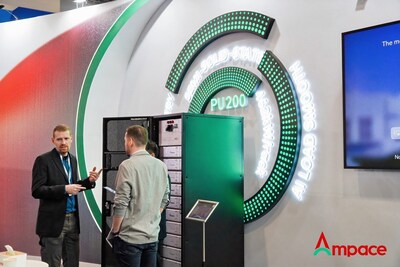
PU Series Designed for Volatile AI Workloads
AI data centers are operating under increasingly demanding conditions. High-density racks are concentrating power demand into smaller footprints, requiring compact systems capable of delivering consistent output without sacrificing reliability.
At the same time, GPU clusters are generating rapid and unpredictable load swings. Power systems need to absorb sudden spikes while maintaining a steady backup supply. The PU Series responds with high-rate capability and stable cabinet-level output, supporting continuity under dynamic AI workloads.
Thermal pressure is also intensifying. Elevated ambient temperatures and sustained computational loads are testing system resilience. The PU architecture enables module natural cooling, helping facilities maintain consistent performance without interruption.
Together, these capabilities are reinforcing one essential objective: continuous, stable power in AI-driven environments where downtime is no longer acceptable.
Semi-Solid LFP Cells Power Resilience in AI Environments
As rack power levels rise, intrinsic battery safety is becoming a primary engineering concern.
Ampace's semi-solid LFP cell technology is eliminating free electrolyte within the cell structure, effectively removing leakage pathways over the product lifespan. This design significantly lowers the probability of insulation-related failure mechanisms.
In controlled testing environments, the semi-solid design is demonstrating approximately 58% lower thermal runaway gas release compared with conventional LFP architectures under similar conditions. By minimizing combustible gas generation and improving thermal stability, the technology is reducing the potential for fire propagation in high-density rack systems.
The system has obtained UL 9540A certification, validating fire propagation resistance through standardized large-scale testing.
Beyond safety, the semi-solid structure is also contributing to longer service life and enhanced operational reliability — essential for AI data centers operating under continuous, high-load conditions.
What's Next: Advancing AI Continuity Infrastructure Worldwide
At DCW London 2026, AI Continuity Infrastructure is being positioned as a long-term framework rather than a single product release. Stable dynamic response, thermal resilience, and intrinsic safety are forming the foundation of Ampace's approach to AI data center energy.
Ampace solutions are already supporting large-scale and AI-focused data centers across multiple regions worldwide, including projects in India, China, Korea, Japan, and Indonesia. These deployments are operating in environments defined by high computational density, elevated thermal conditions, and strict power continuity requirements, demonstrating the adaptability and reliability of Ampace systems under real-world operating pressures.
Looking ahead, Ampace is continuing to expand AI Continuity Infrastructure globally — delivering more advanced, resilient, and scalable power solutions to meet the evolving demands of AI-driven data centers worldwide.
Photo - https://mma.prnewswire.com/media/2926964/image.jpg
 View original content:https://www.prnewswire.co.uk/news-releases/ampace-is-advancing-ai-continuity-infrastructure-at-dcw-london-2026-302705180.html