ACE Safety: Sungrow PowerKeeper Achieves Industry-First Triple UL 9540A Certification
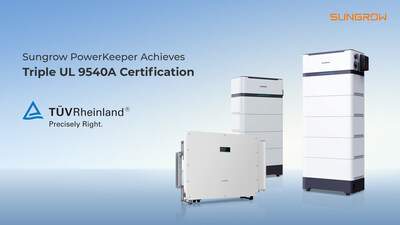
HEFEI, China, April 7, 2026 /PRNewswire/ -- Sungrow's commercial and industrial (C&I) energy storage system PowerKeeper has successfully completed cell, module, and unit-level thermal runaway tests under the UL 9540A standard, becoming the industry's first modular DC-coupled C&I ESS to achieve triple-level certification. Witnessed by TÜV Rheinland, the testing validates PowerKeeper's ability to effectively prevent thermal runaway propagation across multiple system layers—setting a new benchmark for safety in commercial and industrial energy storage.
Beyond Single-Level Testing: A New Approach to Energy Storage Safety
In commercial and industrial environments such as shopping malls, office buildings, hotels, and factories, energy storage systems are often installed in high-density spaces where people, equipment, and valuable assets coexist. Given these scenarios, safety requirements extend far beyond basic compliance. The fundamental challenge in battery safety is not simply responding to fire incidents, but preventing thermal runaway propagation before risks escalate.
UL 9540A is widely recognized as the global benchmark for evaluating thermal runaway risks in energy storage systems. However, current industry practice typically focuses on single-tier testing, either by validating cell-level parameters alone or by demonstrating compliance only at the module or system level. Such fragmented testing cannot fully demonstrate whether every safety barrier within a system can contain potential risks.
PowerKeeper addresses this challenge through a comprehensive triple-layer safety validation approach.
Building a Complete Safety Evidence Chain
Through its cell-module-unit triple UL 9540A certification, PowerKeeper establishes a complete safety validation chain across three system layers:
- Cell-level testing captures critical thermal runaway parameters.
- Module-level testing verifies that thermal runaway can be contained within the battery module.
- Unit-level testing demonstrates effective thermal isolation between adjacent cabinets and surrounding structures.
These interconnected layers of validation assures that PowerKeeper can maintain system integrity even under extreme conditions.
Validated Under Real Installation Constraints
Commercial and industrial sites often have limited installation space, requiring energy storage systems to be placed close to walls or adjacent to other cabinets. PowerKeeper enables seamless, space-efficient installation, adapting effortlessly to diverse and complex site conditions.The test simulates real-world installation scenarios, with clearances set at just 25 mm from walls and 450 mm between cabinets.
- Unit-level test
The triggered battery cell reached a peak temperature of 595.2°C. Even under such extreme conditions, PowerKeeper demonstrated exceptional containment capability.
- No Impact on Adjacent Cabinets
Despite a unit spacing of only 450 mm, the neighboring unit recorded a maximum surface temperature of 13.7°C, far below the 141.3°C threshold defined by UL 9540A.
- Safe Operation with Minimal Wall Clearance
At a wall clearance of just 25 mm, the temperature rise on the wall surface was merely 29°C , significantly below the 97°C limit specified by the standard.
- Module-Level: Precision Mitigation
In the module-level test, thermal runaway was intentionally triggered in three cells. The results were conclusive: no combustion, no explosion, and zero external debris or splashing. This confirms that any potential hazards are strictly contained within the PACK, even under triggered conditions.
- Cell-Level: Control at the Source
The cell's explosion-proof valve activated instantly, successfully releasing pressure and preventing any combustion or explosion, while capturing the precise thermal runaway trigger temperature of 216.3°C during cell-level testing.
These results confirm that PowerKeeper can safely operate even in space-constrained environments, effectively containing potential risks within tightly controlled boundaries.
From Passive Protection to Intelligent Safety
While UL 9540A certification validates PowerKeeper's passive safety performance under extreme conditions, Sungrow has also integrated advanced active safety mechanisms to protect everyday operation.
Aligned with the PowerKeeper "7 Ups" safety concept, the system incorporates:
- 5D alerts (current, voltage, smoke, full-stack temperature monitoring, and water immersion detection)
- Triple-guard protection across cell, pack, and plant levels
Together, these features establish a comprehensive cell-to-plant safety architecture, enabling early risk detection, precise warning, and rapid intervention during daily operation.
Setting a New Safety Benchmark for C&I Energy Storage
The successful completion of cell-module-unit UL 9540A test for PowerKeeper not only provides authoritative validation of the system's safety performance, but also marks a significant step forward in advancing system-level safety standards for the global C&I energy storage market.
As the demand for commercial and industrial energy storage accelerates worldwide, Sungrow remains committed to delivering safe, reliable, and intelligent energy solutions, empowering businesses to transition toward a more sustainable energy future with confidence.
About Sungrow
Sungrow, a global leader in renewable energy technology, has pioneered sustainable power solutions for over 29 years. As of Dec 2025, Sungrow has installed over 1000 GW of power electronic converters worldwide. The company is recognized as the world's most bankable PV inverter and energy storage company (BloombergNEF). Its innovations power clean energy projects across the globe, supported by a network of 520 service outlets guaranteeing excellent customer experiences. At Sungrow, we're committed to bridging to a sustainable future through cutting-edge technology and unparalleled service. For more information, please visit: www.sungrowpower.com/en
Photo - https://mma.prnewswire.com/media/2949617/Sungrow_PowerKeeper_Achieves_Industry_First_Triple_UL_9540A_Certification.jpg
Logo - https://mma.prnewswire.com/media/1344575/Logo.jpg
 View original content:https://www.prnewswire.co.uk/news-releases/ace-safety-sungrow-powerkeeper-achieves-industry-first-triple-ul-9540a-certification-302735177.html